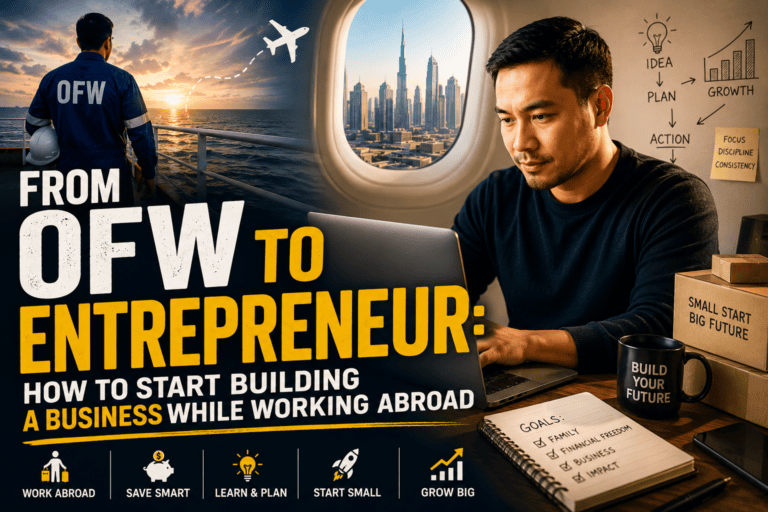

How to Start a Small Business in the Philippines With Your OFW Savings
After years of working abroad, many OFWs return home with one important question:
“What should I do with my savings?”
Unfortunately, many OFWs make the same mistake.
They spend years earning money overseas, return home, start a business without a plan, and lose a significant portion of their hard-earned savings.
I’ve seen it happen countless times.
In fact, I made expensive business mistakes myself.
That’s why I believe every OFW should approach business differently.
Your savings are not just money.
They represent years of sacrifice, missed family moments, long work hours, and time you can never get back.
Protecting that capital should be your first priority.
Step 1: Don’t Start Big
One of the biggest mistakes returning OFWs make is trying to build a large business immediately.
They invest all their savings into:
- Large restaurants
- Construction businesses
- Retail stores
- Franchises
- Expensive equipment
The thinking is simple:
“Go big or go home.”
The reality is often different.
Big businesses create big risks.
Instead, start small.
Test the market.
Learn the business.
Make mistakes while the stakes are low.
Then scale.
Step 2: Choose a Business You Understand
Never invest in a business simply because someone told you it is profitable.
Many OFWs lose money because they invest in industries they know nothing about.
Ask yourself:
- What skills do I already have?
- What industry do I understand?
- What problems can I solve?
For example:
As a chef, food-related businesses naturally make more sense for me than industries I’ve never worked in.
Experience reduces risk.
Step 3: Keep Emergency Savings Separate
One of the most dangerous mistakes entrepreneurs make is investing every peso they have.
Never put all your money into a business.
Always maintain an emergency fund.
Businesses take time to become profitable.
Unexpected expenses happen.
Cash flow problems happen.
A separate emergency fund protects your family while the business grows.
Step 4: Start With Cash Flow Businesses
Focus on businesses that generate consistent cash flow.
Examples include:
Food Businesses
- Carinderia
- Food carts
- Catering
- Specialty food products
Service Businesses
- Digital marketing services
- Website development
- Graphic design
- Virtual assistance
Property Businesses
- Boarding houses
- Dormitories
- Apartment rentals
Cash flow creates stability.
Stability creates options.
Step 5: Invest in Skills First
Before investing heavily in a business, invest in yourself.
Learn:
- Marketing
- Sales
- Customer service
- Financial management
- AI tools
- Social media
The more skills you develop, the higher your chances of success.
Skills often produce a higher return than equipment.
Step 6: Validate Before Scaling
Many entrepreneurs assume demand exists.
Successful entrepreneurs verify demand.
Before expanding:
- Test your product.
- Get paying customers.
- Collect feedback.
- Improve the offer.
Let the market tell you what works.
Never assume.
Step 7: Build Multiple Income Streams
The goal isn’t simply to replace your OFW income.
The goal is to create multiple sources of income.
Examples:
- Small business
- Rental property
- Digital business
- Investments
- Affiliate marketing
Multiple streams create financial security.
One source creates dependence.
Businesses I Believe Have Strong Potential for OFWs
If I were starting from scratch today, I would seriously consider:
1. Digital Businesses
Low startup cost.
High scalability.
Can be operated from anywhere.
2. Rental Properties
Consistent cash flow.
Long-term appreciation.
3. Food Businesses
Especially for people with hospitality experience.
4. Service-Based Businesses
Skills can be monetized immediately.
5. Content Creation and Personal Branding
Attention is becoming one of the most valuable assets in the modern economy.
The Biggest Lesson
The goal isn’t to become a business owner.
The goal is to become a profitable business owner.
Many people rush into entrepreneurship.
Successful entrepreneurs focus on preparation.
Remember:
Your OFW savings represent years of sacrifice.
Treat that capital with respect.
Protect it.
Grow it.
Use it wisely.
Final Thoughts
Working abroad gives you something valuable:
Capital.
But capital alone isn’t enough.
To build long-term wealth, you need skills, systems, discipline, and patience.
Start small.
Learn fast.
Avoid unnecessary risks.
Focus on cash flow.
And most importantly, remember that building a successful business is a marathon, not a sprint.
Your OFW savings can become the foundation of financial freedom.
But only if you use them strategically.