5 Reasons Many OFWs Return Home With No Savings
For many Filipinos, becoming an OFW is supposed to be the solution to financial problems.
The dream is simple: work abroad, earn a higher income, save money, build a better future, and eventually return home financially secure.
But the reality is often different.
After years—even decades—of working overseas, many OFWs come home with little to no savings. Some even return with debt.
I know this because I’ve seen it happen countless times. I’ve worked overseas myself and met many hardworking Filipinos who sacrificed years away from their families, only to struggle financially when their contracts ended.
The truth is, the problem is rarely income.
The problem is what happens to that income.
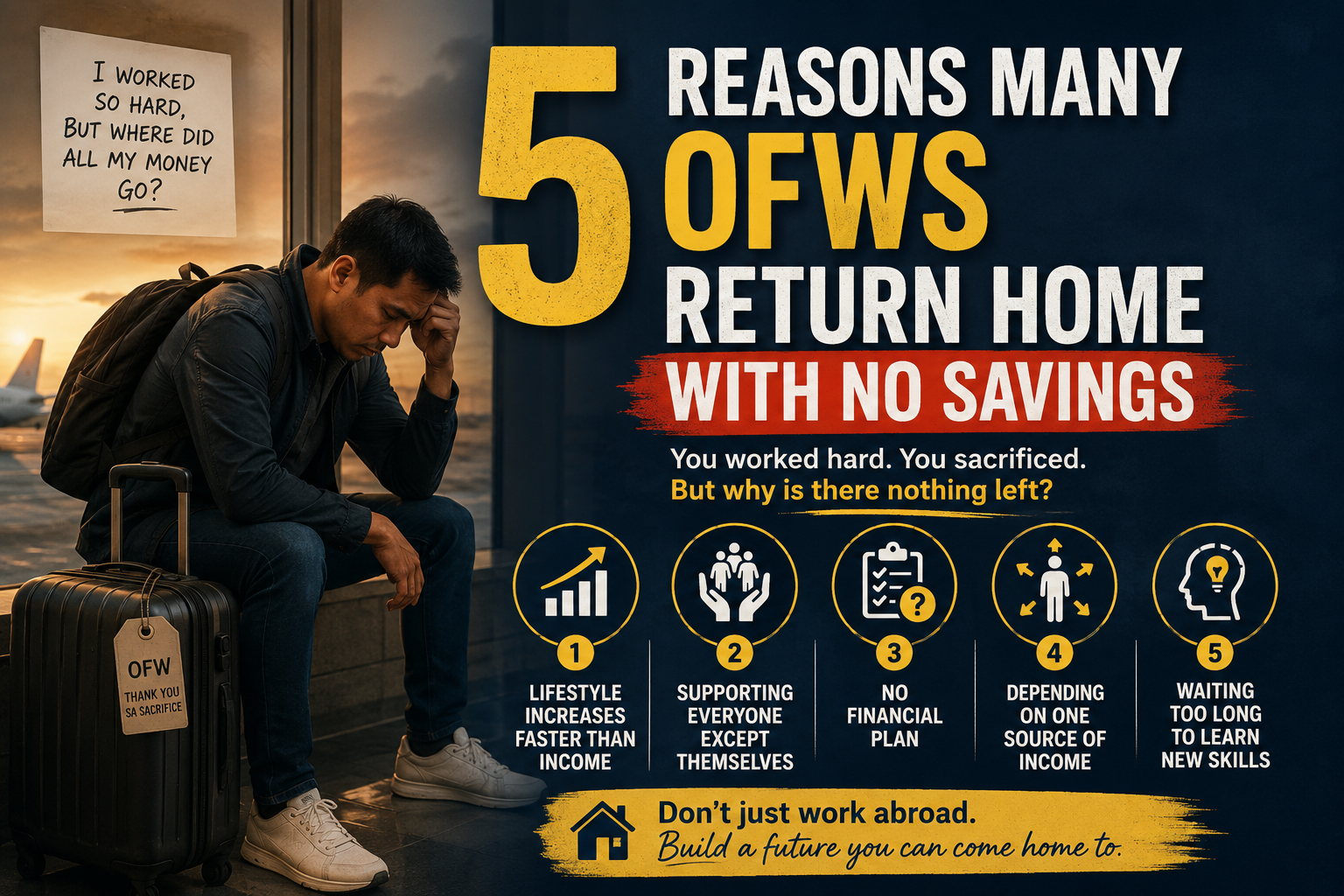
Here are five reasons many OFWs return home with no savings.
1. Lifestyle Increases Faster Than Income
One of the biggest traps is lifestyle inflation.
The moment income increases, expenses increase too.
A new phone.
A bigger house.
A new motorcycle.
More shopping.
More monthly payments.
There’s nothing wrong with enjoying the fruits of your labor. The problem starts when every salary increase is immediately spent instead of invested.
Many OFWs earn more but never build assets because their lifestyle grows as fast as their paycheck.
The result?
Years of hard work with very little to show for it.
2. Supporting Everyone Except Themselves
Filipinos are naturally generous.
Many OFWs become the family’s financial lifeline.
Parents need support.
Siblings need help.
Relatives ask for loans.
Friends ask for favors.
While helping family is admirable, many OFWs sacrifice their own future in the process.
They send money to everyone else but never pay themselves first.
A simple rule that can change everything:
Save and invest at least 10% of every paycheck before spending anything else.
Even small amounts compound over time.
3. No Financial Plan
Many OFWs have a destination but no roadmap.
They work hard every day but never define specific financial goals.
Questions like these are often unanswered:
- How much do I want to save?
- When do I want to retire?
- What assets am I building?
- What investments am I making?
- What business will support me when I stop working?
Without a plan, money tends to disappear.
Successful people don’t just earn money.
They give every peso a purpose.
4. Depending On One Source Of Income
Many OFWs rely entirely on their salary.
When the contract ends, the income stops.
When an emergency happens, the income stops.
When health issues arise, the income stops.
That’s why building multiple income streams is so important.
This doesn’t mean chasing every opportunity online.
It means developing skills, building systems, and creating assets that can generate income beyond your physical labor.
The goal is simple:
Move from trading time for money to building income-producing assets.
5. Waiting Too Long To Learn New Skills
The world changes fast.
The skills that paid well ten years ago may not provide the same opportunities today.
Many OFWs postpone learning because they’re busy working.
I understand that.
I worked long hours as a chef while trying to learn digital marketing and online business after work.
It wasn’t easy.
But learning new skills completely changed the direction of my life.
The highest-paid people are often not the hardest workers.
They’re the people with the most valuable skills.
Investing in yourself may produce the highest return you’ll ever receive.
Final Thoughts
Most OFWs are not failing because they’re lazy.
In fact, they’re some of the hardest-working people in the world.
The challenge is that hard work alone is not enough.
Income must be paired with saving.
Saving must be paired with investing.
And investing must be paired with building assets and valuable skills.
Your goal should not simply be to work abroad.
Your goal should be to create a future where working becomes a choice, not a necessity.
The best time to start building that future is today.
Because one day, every OFW comes home.
The question is:
Will you come home with memories only, or with the financial freedom you worked so hard to achieve?