From Italy OFW to Entrepreneur: How a Woman From Naujan Built a Business From Five Cavans of Rice
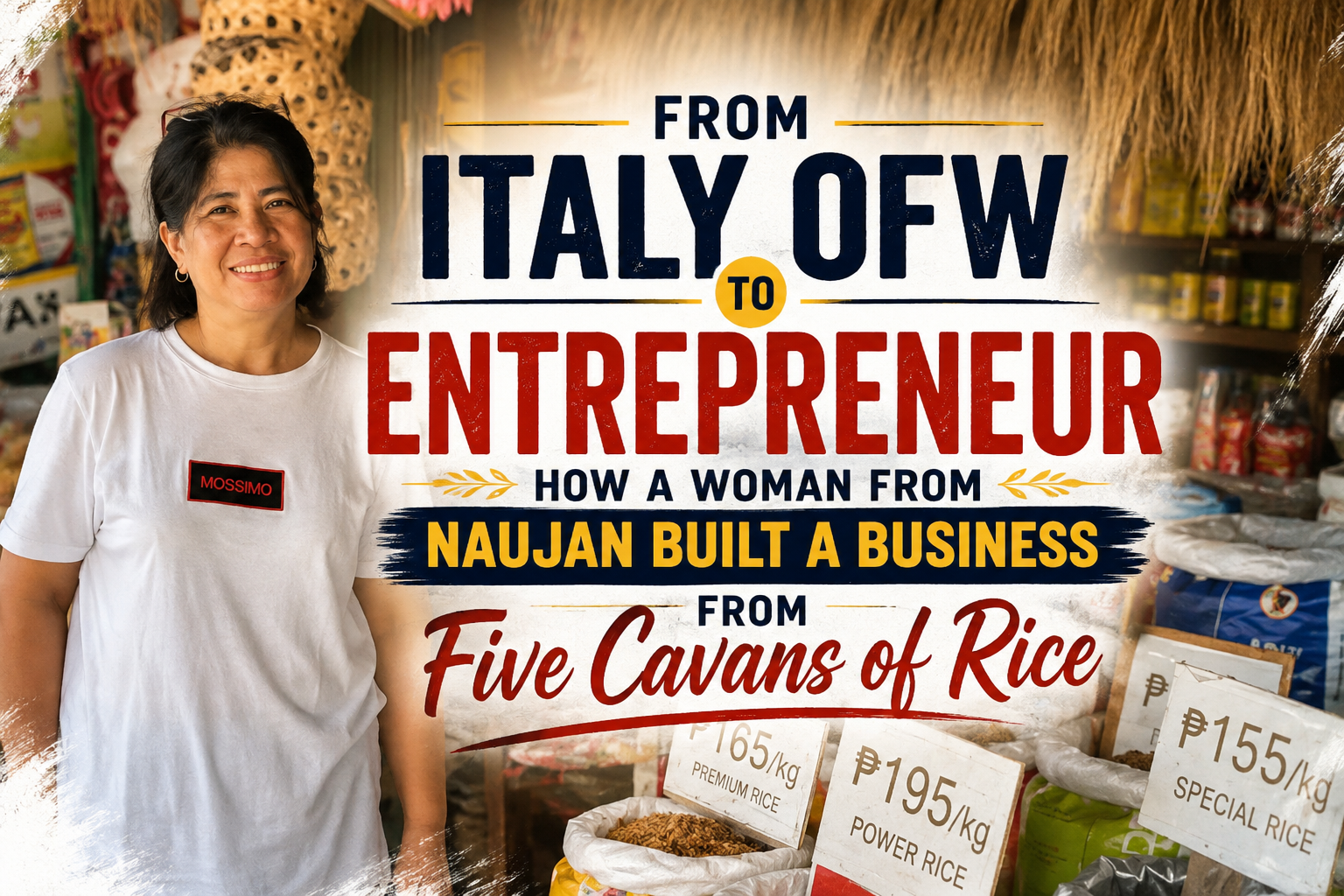
When Leonila H. Flores returned to Naujan, Oriental Mindoro, in 2005 after working in Italy, she decided to use her savings to build a livelihood back home.
She started with capital equivalent to five cavans of rice.
From that modest beginning, Flores built L.H. Flores Store at the Naujan Public Market and gradually expanded her customer base to retailers in Naujan and nearby Calapan City.
In 2023, she became the first recipient of the “Bidang Manininda” recognition in Oriental Mindoro, an award given for her customer service, fair business practices, and commitment to consumers.
Flores Started With Five Cavans of Rice
Flores returned to Naujan after working in Italy with the goal of creating a sustainable livelihood for her family.
She did not have formal business training or a large amount of capital.
Instead, she started small by opening a store at the Naujan public market.
Her initial capital was equivalent to five cavans of rice.
The first year was challenging. Customers were limited, and she was still learning how to operate a business.
Rather than expanding quickly, she focused on building the business one customer at a time.
Her Customer Base Grew Gradually
As Flores gained experience, she began supplying more retailers in Naujan.
Her customers eventually extended to Calapan City, allowing the business to grow beyond the immediate market.
As demand increased, she rented an additional stall to accommodate more products and customers.
The growth of L.H. Flores Store did not come from one large investment.
It developed gradually through regular customers, repeat transactions, and relationships with retailers.
For a small business, this kind of organic growth can be more sustainable than expanding before there is enough demand.
Customer Trust Became a Key Part of the Business
Flores focused heavily on customer service and fair business practices.
According to the Philippine Information Agency, she emphasized:
- Fair trade practices
- Transparent transactions
- Compliance with consumer laws
- Good customer service
- Respectful treatment of customers
These practices helped her develop a loyal customer base.
For a market business, trust can become one of the most valuable assets.
A customer who receives good service has a reason to return. A retailer who trusts a supplier has a reason to continue ordering.
Flores’ experience shows that building a business is not only about finding products to sell. It is also about building relationships with the people who buy them.
The Business Faced Cash Flow Challenges
Like many small businesses, Flores also encountered problems with cash flow.
Some customers purchased goods on credit, meaning products were sold before the money was collected.
This created pressure on the business because the money needed to purchase new inventory was sometimes still with customers.
The experience highlights an important business principle:
Sales are not the same as cash flow.
A business can have customers and sales but still struggle if too much money is tied up in unpaid accounts.
For small entrepreneurs, managing credit, inventory, expenses, and collections is essential to keeping the business operating.
A Typhoon Destroyed Her Market Stall
In 2017, a powerful typhoon destroyed Flores’ market stall.
After years of building the business, she had to start rebuilding again.
The setback was followed by another major challenge when the COVID-19 pandemic disrupted businesses and supply chains.
Market restrictions and changes in operations made it difficult for small businesses to maintain normal operations.
Despite these setbacks, Flores continued operating.
Her ability to recover became an important part of her entrepreneurial journey.
Business Training Helped Her Become More Resilient
Flores eventually received assistance from the Department of Trade and Industry Oriental Mindoro and the Negosyo Center Naujan.
She participated in Business Continuity and Resiliency Planning training, which helped her understand how to prepare the business for future disruptions.
She was also introduced to financing programs through the Small Business Corporation.
With assistance from the Negosyo Center, she was able to obtain financing to replenish inventory and renovate her market stall.
She also received assistance through the Department of Social Welfare and Development’s Sustainable Livelihood Program.
The experience shows why business owners need to think beyond daily sales.
A sustainable business also needs plans for unexpected problems such as:
- Natural disasters
- Supply disruptions
- Cash flow shortages
- Changes in customer demand
- Economic downturns
- Unexpected operating expenses
Flores Became Oriental Mindoro’s First “Bidang Manininda”
In October 2023, Flores was named the first “Bidang Manininda” of Oriental Mindoro during the Department of Trade and Industry’s “Pamilihang Magiliw” search for the province’s most consumer-friendly public market and market vendor.
She also received special awards for:
- Best in Compliance with Fair Trade and Other Consumer-Related Laws
- Best in Customer Relations and Services
The recognition reflected the way she had built her business over the years.
Her success was not based only on the number of products she sold.
It was also based on how she treated customers and operated the business.
What OFWs Can Learn From Her Story
Flores’ experience offers several practical lessons for Filipinos who are working abroad or preparing to return home.
Start With What You Have
Flores did not wait until she had enough capital to build a large business.
She started with the equivalent of five cavans of rice.
For a returning OFW, the goal does not have to be building a large company immediately.
A better approach may be to start with a smaller operation, prove that customers exist, and reinvest the profits.
Build Customers Before Expanding
Flores gradually expanded her customer base from Naujan to Calapan.
This allowed the business to grow according to actual demand.
Entrepreneurs can apply the same principle by finding customers first and expanding operations as sales become consistent.
Protect Cash Flow
The credit arrangements with some customers created challenges for Flores.
This is a reminder that entrepreneurs need to monitor:
- Cash coming into the business
- Operating expenses
- Inventory
- Customer receivables
- Supplier payments
- Available working capital
A profitable business can still experience problems when cash is not available at the right time.
Customer Service Can Become a Competitive Advantage
Flores’ recognition for customer relations demonstrates the value of treating customers well.
For small businesses competing against larger companies, personal service and trust can become significant advantages.
Customers remember businesses that treat them fairly.
Prepare for Problems Before They Happen
Flores experienced both a destructive typhoon and the COVID-19 pandemic.
Those events demonstrated why business continuity matters.
Entrepreneurs should consider what would happen if their store closed temporarily, suppliers stopped delivering, or sales suddenly declined.
Planning for those situations can make recovery faster.
Use Available Resources
Flores benefited from training and assistance provided through DTI, the Negosyo Center, and other government programs.
Returning OFWs and small business owners should investigate similar programs in their local communities.
Business training, financing programs, mentoring, and government assistance can provide useful support during the early stages of a business.
From Working in Italy to Building in Naujan
Flores’ journey represents a path familiar to many Filipino OFWs.
Work abroad.
Save money.
Return home.
Start something small.
Build customers.
Then gradually expand.
The difference is what happens after returning home.
Some OFWs use their savings primarily for consumption and household expenses. Others use part of their savings to create an income-producing asset.
Flores chose the second path.
Her overseas work gave her the opportunity to accumulate the capital she eventually used to start her business.
But capital alone did not build L.H. Flores Store.
The business also required years of customer service, persistence, financial management, adaptation, and willingness to learn.
A Small Beginning Can Become a Long-Term Business
Leonila H. Flores started her entrepreneurial journey in Naujan with capital equivalent to five cavans of rice.
She built her customer base gradually.
She dealt with cash flow problems.
She survived the destruction of her market stall.
She adapted during the pandemic.
She accepted training and assistance.
And eventually, she became Oriental Mindoro’s first “Bidang Manininda.”
Her story is a useful reminder for OFWs preparing for life after overseas employment.
You do not necessarily need millions of pesos to start.
You need a realistic business model, customers who are willing to pay, disciplined money management, and the patience to build over time.
The most important question for an OFW may not simply be:
“How much can I earn abroad?”
It may be:
“What can I build with what I earn while I’m abroad?”
For Leonila Flores, the answer started with five cavans of rice.
Today, that small beginning stands as an example of what can happen when an OFW returns home and turns limited capital into a business built around customers, trust, and persistence.
Source
This article is based on a Philippine Information Agency feature published on February 19, 2026, using information and photographs from DTI Oriental Mindoro and Negosyo Center Naujan.