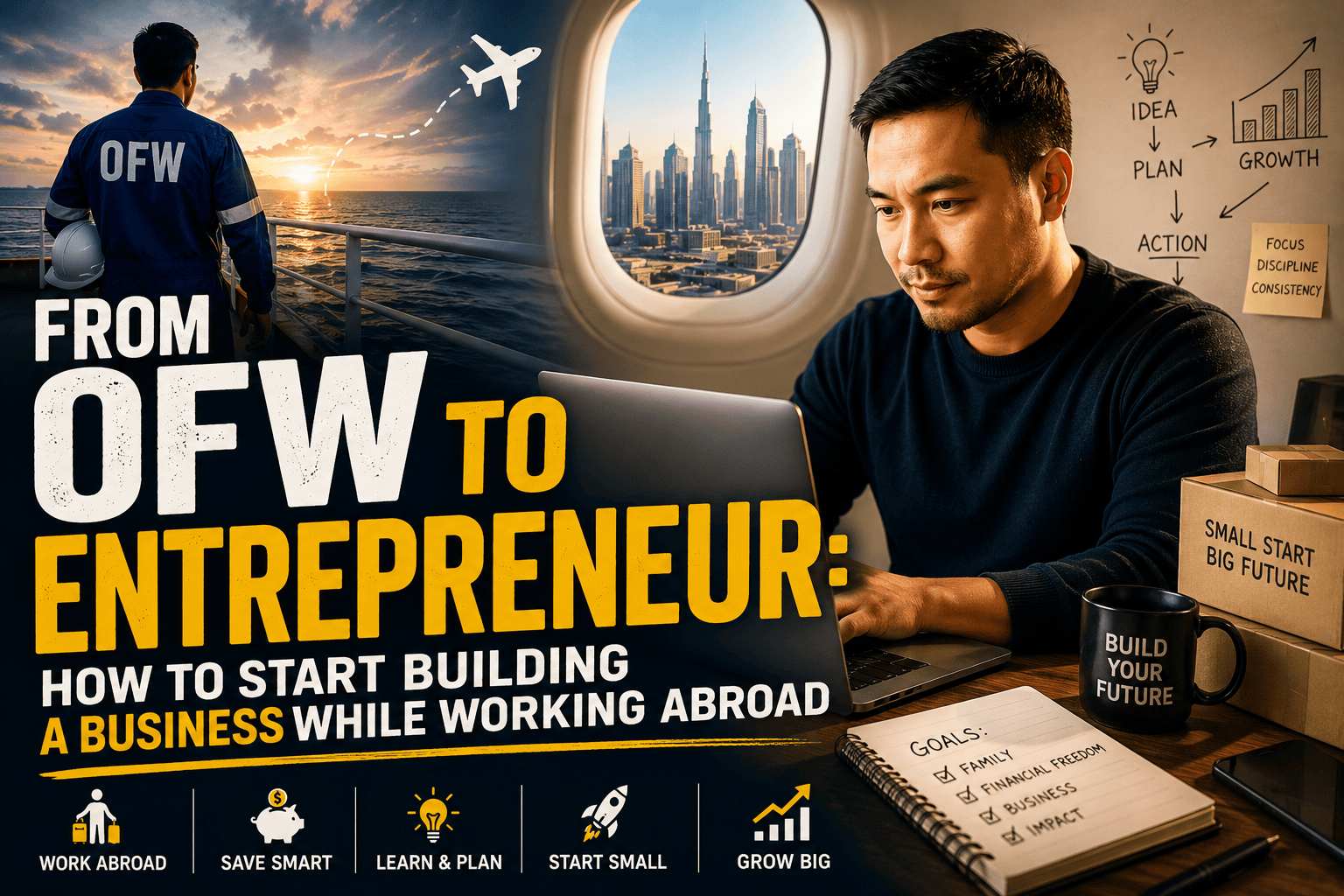
From OFW to Entrepreneur: How to Start Building a Business While Working Abroad
For many Filipinos, becoming an OFW is a way to provide a better life for their family.
You work abroad. You earn in a stronger currency. You send money home. You pay bills, tuition, loans, and other expenses.
But here’s the question more OFWs need to ask:
What happens when the salary stops?
Your job can provide income, but a business can potentially create an asset.
That doesn’t mean every OFW needs to quit their job and become an entrepreneur tomorrow. In fact, I believe the opposite.
Your OFW job can become the funding engine for your future business.
The goal is not to choose between employment and entrepreneurship.
The goal is to use your current situation strategically.
Your Salary Should Be More Than Money for Today
One of the biggest mistakes an OFW can make is treating every paycheck as spending money.
Of course, your family needs support. That’s part of why you work abroad.
But if 100% of your income goes toward consumption, bills, and lifestyle, you may eventually find yourself back at zero when your contract ends.
A better approach is to divide your income into different purposes:
- Family needs
- Emergency savings
- Debt reduction
- Investments
- Business capital
- Personal development
You don’t have to start with thousands of dollars.
You need to start with a system.
Small amounts consistently invested into a productive asset can become more valuable than constantly increasing your lifestyle.
Don’t Quit Your Job Too Early
This is one of the most important principles for an OFW who wants to become an entrepreneur.
Don’t confuse having a business idea with having a business.
You might have an idea for a restaurant, online store, real estate business, food brand, digital agency, or reseller business.
That’s great.
But before you leave your job, prove that people are willing to pay.
Your OFW job gives you something extremely valuable:
cash flow.
Use that cash flow to test your business.
Start small.
Get your first customers.
Learn how to sell.
Improve the product.
Track your numbers.
Then scale what works.
The transition should ideally look like:
Job → Side Hustle → Small Business → Consistent Profit → Scalable Business → Financial Independence
Not:
Job → Resign → Hope the business works.
Start With a Problem, Not a Business Idea
Many aspiring entrepreneurs ask:
“What business should I start?”
A better question is:
“What problem can I solve that people are willing to pay me to solve?”
This changes everything.
For example, instead of saying:
“I want to start a food business.”
Ask:
“What food product do people in my community regularly buy?”
Instead of:
“I want to sell online.”
Ask:
“What product can I sell that solves a specific problem for a specific group of people?”
Instead of:
“I want to become a real estate agent.”
Ask:
“What type of buyer or investor can I help?”
Business becomes much easier when you start with demand.
Choose a Business You Can Operate From Abroad
Not every business is suitable for an OFW.
If you’re working long hours overseas, you probably don’t want a business that requires you to personally supervise everything every day.
Look for businesses that can eventually operate through:
- Online systems
- Employees
- Family members
- Partners
- Resellers
- Automation
- Digital platforms
Some possibilities include:
1. Online Business
Digital products, affiliate marketing, consulting, education, content creation, and online services can potentially be operated remotely.
2. Reselling
You don’t always need to manufacture a product.
You can find a good product, build a customer base, and develop a reseller network.
3. Food Business
Food can be powerful because people buy it repeatedly.
The challenge is creating reliable operations, quality control, packaging, distribution, and inventory systems.
4. Real Estate
Real estate can become a long-term wealth-building vehicle, although it requires proper research, capital planning, and understanding of the market.
5. Service Business
Digital marketing, graphic design, web development, virtual assistance, bookkeeping, and other services can be started with relatively low overhead if you have the right skills.
The best business isn’t necessarily the most exciting one.
It’s the one you can execute consistently and eventually systemize.
Start With Your Existing Skills
You don’t always need to learn something completely new.
Look at what you already know.
If you’re a chef, you already understand food, operations, costing, purchasing, customer service, and kitchen management.
If you’re a seafarer, you understand the challenges of working abroad.
If you’re an engineer, you have technical knowledge.
If you’re in sales, you understand customers and persuasion.
If you’re an accountant, you understand numbers.
Your experience can become your competitive advantage.
Your career may be more than a job. It may be the raw material for your future business.
Build Skills Along the Way
Money isn’t the only thing you should invest in.
Invest in skills.
The most useful entrepreneurial skills include:
Sales.
If you cannot sell, it’s difficult to build a business.
Marketing.
You need to know how to attract attention and communicate value.
Financial management.
Revenue is not profit. Profit is not cash flow. Learn the difference.
Leadership.
Eventually, you need other people to help execute your vision.
Technology.
Learn how modern tools, AI, automation, websites, social media, and digital systems can make your business more efficient.
Communication.
Your ability to explain an idea clearly can become a major business advantage.
Don’t Wait Until You Have “Enough Money”
One of the biggest excuses people make is:
“I’ll start when I have enough capital.”
Sometimes capital is genuinely the problem.
But sometimes the real problem is that the person hasn’t tested the idea.
You don’t need to build the final version immediately.
Build the smallest version that allows you to test demand.
For example:
Instead of opening a restaurant, test a food product.
Instead of building a huge online store, test one product.
Instead of creating a massive course, teach a small workshop.
Instead of buying multiple properties, learn the market and start with one carefully evaluated opportunity.
Validate first. Invest more later.
Use Your OFW Years Strategically
Your years abroad should not only be measured by how much money you send home.
Measure them by what you’re building.
Ask yourself every year:
How much did I save?
How much debt did I eliminate?
What skills did I develop?
What assets did I acquire?
What business did I build?
What systems did I create?
How much income can continue without my physical presence?
These questions change your perspective.
Instead of simply working another contract, you start thinking like an entrepreneur.
Build Your First Customer Before Building Your Big Business
This is another principle I strongly believe in.
Don’t obsess over logos, offices, websites, packaging, or fancy equipment before you know whether customers actually want what you’re selling.
Your first milestone should be simple:
Someone pays you.
Then another person pays you.
Then ten people.
Then fifty.
Then you figure out how to make the process repeatable.
That’s how a business becomes real.
Build Systems, Not Dependence on Yourself
Eventually, your goal shouldn’t be:
“I own a business, but I have to do everything.”
That’s just another job.
The real objective is to create systems.
Document:
- How orders are received
- How customers are followed up
- How products are delivered
- How inventory is tracked
- How payments are collected
- How employees perform tasks
- How customers receive support
- How marketing generates leads
The more repeatable the process becomes, the more valuable the business can become.
Entrepreneurship is not simply about working for yourself. It’s about building something that can work beyond yourself.
Think About Your Exit Before You Start
This doesn’t mean you need to sell your company.
It means you should think about what success actually looks like.
Maybe your goal is to return to the Philippines.
Maybe you want to work fewer hours.
Maybe you want to buy rental properties.
Maybe you want to build multiple businesses.
Maybe you want to create opportunities for your children.
Maybe you simply want your family to have financial security.
Whatever your goal is, define it.
Because if you don’t know where you’re going, your OFW salary can become an endless cycle:
Work → Earn → Send Money → Spend → Repeat.
A business and investment strategy can potentially change that cycle into:
Work → Save → Invest → Build → Systemize → Multiply → Own Assets.
My Advice to OFWs Who Want to Become Entrepreneurs
Don’t rush.
Don’t gamble your family’s security just because someone online promised you “financial freedom.”
Don’t borrow huge amounts of money for an untested idea.
Don’t start five businesses at once.
And don’t compare your beginning with someone else’s tenth year.
Instead:
Start with what you have.
Use your job as your current cash-flow engine.
Use your free time to learn.
Use a small amount of capital to test.
Use your first customers to validate.
Use your profits to reinvest.
Use systems to scale.
And use your business to gradually create assets.
Your OFW Job Can Be the Beginning—Not the End
Working abroad is difficult.
You’re separated from your family. You work long hours. You sacrifice time that you can never get back.
But your OFW years can also become a powerful financial and entrepreneurial chapter of your life.
You can use those years to build skills.
You can build capital.
You can develop relationships.
You can test businesses.
You can invest.
And eventually, you can build something that gives you more choices.
You don’t have to become an entrepreneur overnight.
You simply need to start thinking differently about the money you’re already earning.
Your salary can pay the bills.
Your skills can create opportunities.
Your business can create leverage.
Your assets can create long-term wealth.
And maybe the biggest question isn’t:
“How long do I have to work abroad?”
Maybe it’s:
“What am I going to build while I’m here?”
That question can change the entire direction of your OFW journey.